
 EN
 CN
 ES
 AR
 FR
 PT
 RU
 KO
 JA
 DE




Biomass Pyrolysis: Temperature and Residence Time Effects
Posted on:2026-10-27 15:55:23
1 Overview
1.1 What biomass pyrolysis is
Biomass pyrolysis is a thermochemical process that heats organic feedstock, such as straw, wood chips and rice husk, in an oxygen-free or oxygen-limited environment. The heat breaks the feedstock down into three product streams: bio-oil, the liquid fraction; biochar, the solid residue; and non-condensable gas, the light fraction that does not condense. Because no oxygen is present, the biomass does not burn; instead it decomposes, and the proportions of the three products depend on the operating conditions.
Among all controllable variables, temperature and residence time have the strongest effect on product distribution and quality. They do not act independently. Even at the same final temperature, a different time spent by the vapors and solids in the hot zone produces a different mixture. An operator who understands the two parameters can steer the reactor toward the product actually needed, rather than accepting whatever ratio the furnace happens to produce.
2 Temperature: the primary lever
2.1 How temperature shapes product distribution
Temperature governs the extent of chemical bond cleavage and the stability of the intermediate vapors. At low furnace temperatures, roughly 350 to 450 degrees Celsius with slow heating, the biomass mainly undergoes slow carbonization. Depolymerization proceeds gently, volatiles escape gradually and the residue becomes a stable biochar with a high yield. At intermediate temperatures, roughly 450 to 550 degrees Celsius, the balance shifts: more volatiles are released, some condense into bio-oil, and char yield falls to a middle range. Above about 550 to 650 degrees Celsius with rapid heating, fragmentation intensifies, tar and heavy molecules crack into lighter components, and bio-oil plus gas become dominant while char drops sharply.
2.2 Temperature regimes and process naming
Because yield and quality respond so strongly to temperature, the process is usually named after this parameter. Slow pyrolysis targets char, fast pyrolysis targets liquid, and flash pyrolysis pushes the mixture further toward gas. The furnace must therefore be rated and insulated for the intended temperature window, since operating far from the design range undermines both yield and repeatability.
3 Residence time: the secondary lever
3.1 Solid residence time
Solid residence time is the period the biomass remains inside the reactor. A longer solid residence favors deeper carbonization and a higher char yield, while a shorter one leaves more volatiles unconverted. It is largely set by the feed rate and the reactor volume, and it determines how completely the feedstock is decomposed before discharge.
3.2 Vapor residence time and secondary cracking
Vapor residence time is the period the evolved gas spends in the hot zone before being quenched. A longer vapor residence gives secondary cracking more chance to convert heavy tars into light gases and smaller molecules, which raises gas yield but can reduce the quality and yield of condensable bio-oil. The two time scales are often coupled in a real furnace: a slow, long-residence process typically produces more char and less liquid, whereas a fast, short-residence process favors bio-oil.
4 Combined temperature-residence effect
4.1 How the two parameters interact
Temperature and residence time do not act in isolation; their interaction determines the final product portfolio. High temperature combined with long vapor residence pushes the process strongly toward gas, because heavy intermediates have enough energy and enough time to crack completely. High temperature with very short residence, by contrast, captures the oil-rich vapors before they break down, maximizing bio-oil yield. Low temperature with long solid residence favors biochar, while low temperature with short residence may leave the feedstock partially unconverted.
4.2 Practical implication for operators
For a plant operator the practical conclusion is straightforward: choose the reaction regime first by selecting the target product, then fix the temperature, and finally tune the residence time through feed rate, reactor volume and quench speed. Adjusting only one variable while ignoring the other frequently produces disappointing yields.
5 Matching parameters to the target product
5.1 Fast pyrolysis for bio-oil
When bio-oil is the objective, the furnace should run in the fast pyrolysis regime: a moderate-high temperature near 500 degrees Celsius, rapid heating and a short vapor residence time, with quick quenching to condense the liquid and suppress secondary cracking.
5.2 Slow pyrolysis for biochar
When biochar is the objective, the operator should run slow pyrolysis: a lower temperature near 400 degrees Celsius and a longer solid residence time to deepen carbonization and raise fixed carbon.
5.3 High-temperature regime for syngas
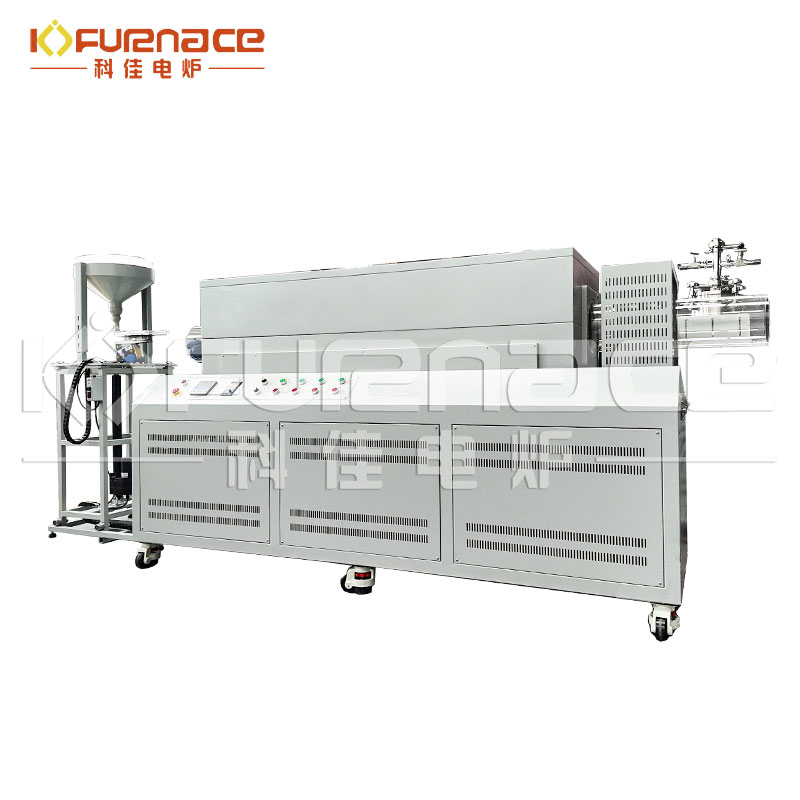
When syngas is the objective, higher temperatures above 650 degrees Celsius with a longer vapor residence time maximize gas yield, at the cost of lower oil and char. Because most commercial demand sits in bio-oil and biochar, the typical compromise is a moderate-temperature fast pyrolysis line. Rotary and fluidized-bed reactors are well suited to this regime because they provide uniform heating, short gas residence and continuous throughput.
6 Practical control and quality monitoring
6.1 Temperature and residence measurement
In practice, yield claims are only as good as the control and measurement that support them. Temperature should be measured at the bed rather than only at the wall, since gradients across the charge are common. Residence time is best tuned through feed rate and quench position, and it should be verified with actual gas flow and condensation efficiency.
6.2 Quality references for products
Product quality should be monitored against fixed references: bio-oil is judged by water content, acidity and viscosity, biochar by fixed carbon and ash, and gas by heating value and tar carryover. Recording temperature and residence data against each batch allows the operator to build a repeatable recipe and to diagnose yield drift early.
Zhengzhou KJ Technology Co., Ltd. is a high-tech enterprise specializing in R&D and sales of heat treatment products, including muffle furnaces, tube furnaces, vacuum furnaces and more, widely used in metallurgy, ceramic sintering, battery materials, semiconductors, aerospace and other fields.
For inquiries and customized solutions, contact us via WhatsApp: +86 18037178440 or Email: web@kejiafurnace.com.
Previous Article:Rotary Tube Furnace: Uniformity and Capacity Advantages of Continuous Powder Calcination and Pyrolys
Next Article:Return to list