
 EN
 CN
 ES
 AR
 FR
 PT
 RU
 KO
 JA
 DE




Rotary Tube Furnace: Uniformity and Capacity Advantages of Continuous Powder Calcination and Pyrolys
Posted on:2026-10-27 15:41:23
1. Overview of the Rotary Tube Furnace and Continuous Calcination and Pyrolysis
1.1 Furnace structure and working principle
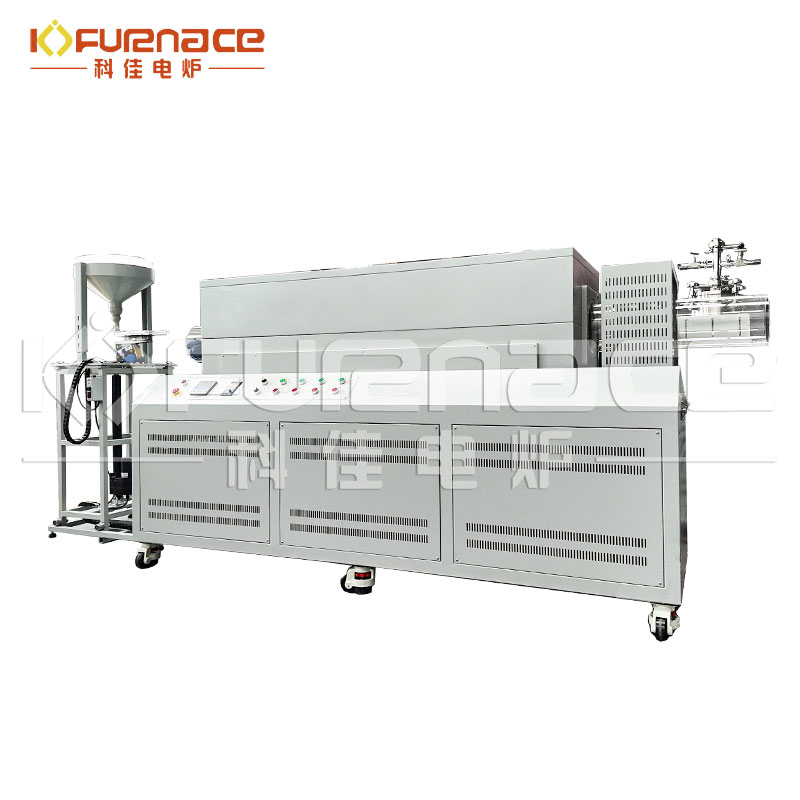
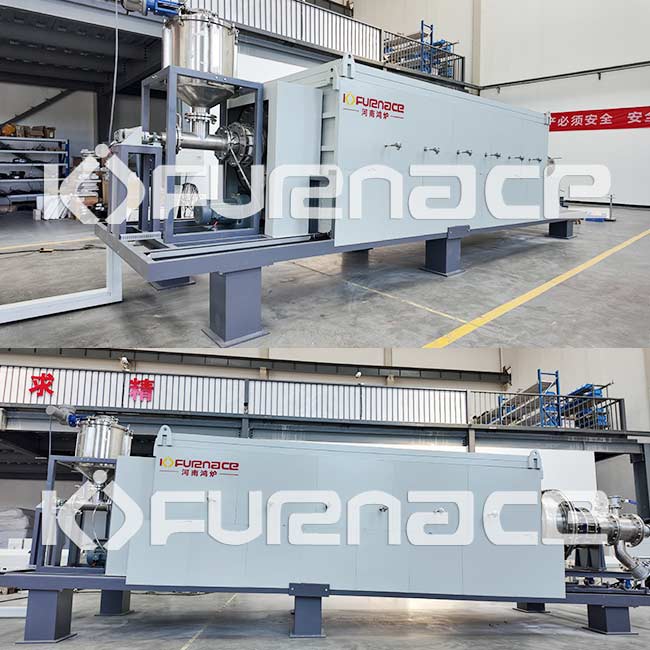
A rotary tube furnace keeps powder constantly tumbling by rotating the tube, combined with continuous feeding and discharging and zoned temperature control, to complete calcination, pyrolysis and heat treatment of powders under an inert or reactive atmosphere, delivering high uniformity and scalable continuous production.The furnace consists of a tilted rotating tube, a heating zone, feed and discharge devices and an atmosphere system. Powder enters continuously from one end, advances along the axis by tube rotation and gravity, passes sequentially through preheating, calcination/pyrolysis and cooling zones, and exits continuously from the other end. Compared with a static tube furnace, the rotary tumbling keeps the powder constantly mixed, avoiding pile sintering and local overheating.
1.2 Typical applications and process value
The rotary tube furnace is widely used for continuous calcination, pyrolysis and activation of lithium-battery cathode and anode materials, catalysts, ceramic powders and carbon materials, and is a core device for scaled-up powder heat treatment.The continuous process removes the loading, unloading and cooling waiting of batch furnaces, raising throughput and equipment utilization; uniform tumbling keeps every batch heated consistently, stabilizing particle size, structure and performance. Compared with a static tube furnace, rotary tumbling avoids powder pile sintering and local overheating, especially suiting powders that need long, uniform heat treatment.
2. Mechanism Behind Powder Uniformity
2.1 Rotary tumbling and mixing
Tube rotation keeps powder constantly rolling and mixing, so particles continuously exchange contact surfaces, heating evenly and avoiding local overheating and agglomeration.The tumbling from rotation swaps the upper and lower layers of powder, letting heat and atmosphere reach every particle evenly and preventing the temperature gradient and sintering agglomeration caused by static stacking. Rotation speed and tilt angle control the tumbling intensity and residence time and should be adjusted to the powder characteristics.2.2 Zoned temperature control and atmosphere uniformity
Multi-zone independent control builds a stable temperature distribution, and continuous atmosphere flow makes the reaction environment uniform, ensuring calcination and pyrolysis consistency.
The preheating zone slowly ramps to release volatiles, the calcination zone holds the reaction temperature, and the cooling zone cools by program. Each zone sets its own temperature, powder passes through the full thermal history sequentially along the axis, and atmosphere flows continuously through the bed, so reactions are uniform and controllable with reduced within-batch variation.
3. Continuous Capacity and Scale-Up Advantages
3.1 Continuous feeding and discharging
Continuous operation eliminates the loading, unloading, heating and cooling wait time of batch furnaces, markedly raising equipment utilization and per-unit-time throughput.Powder keeps entering and leaving, the hot zone always stays at working temperature with no repeated ramping, giving high energy efficiency and a stable production cadence that suits large-scale industrial production.
3.2 Process stability and automation
Continuous processing with automated control keeps material transport, temperature, rotation speed and atmosphere parameters stable and repeatable, giving good batch consistency and low labor demand.Continuous operation keeps process parameters stable over the long term. Combined with online monitoring and automatic control, it enables unattended continuous production, reducing labor and quality fluctuation and suiting scaled production lines.
4. Process Parameters and Operating Essentials
4.1 Rotation speed, tilt angle and residence time
Rotation speed, tube tilt and feed rate together determine residence time and tumbling intensity, and must be matched to the reaction requirements.Residence time decides how completely the reaction proceeds, and tumbling intensity affects uniformity. Too high a speed tumbles the powder vigorously but shortens residence, while too low a speed allows stacking; set these by considering powder flowability, particle size and reaction kinetics to ensure full reaction and even heating.
4.2 Temperature zoning and atmosphere control
Set zone temperatures and the ramp curve by material, with an inert or reactive atmosphere flowing continuously to prevent oxidation and contamination.Calcination and pyrolysis are atmosphere-sensitive, so backfill with high-purity inert or reactive gas and control the flow; sealing and pressure protection keep the atmosphere pure and prevent air ingress from oxidizing the powder.
5. Common Problems and Countermeasures
Most problems trace to insufficient tumbling, uneven heating or atmosphere leakage, and each has a practical fix.Powder sintering and agglomeration follow too low a rotation speed, local overheating or an overlong residence time; raise the speed, optimize the temperature zoning and control the residence time. Inconsistent batch performance comes from an uneven temperature field or feed-rate fluctuation; use multi-zone control and stabilize the feed and rotation parameters. Oxidized or contaminated powder follows atmosphere leakage or low vacuum; strengthen sealing and raise the atmosphere flow and purity. Low output follows too small a tilt or insufficient feed; increase the tilt, raise the feed rate and optimize the residence time.
6. Selection Guidance and Summary
6.1 Scenario-based selection
Select by material properties, processing temperature, atmosphere and output: choose a rotary tube furnace for continuous large-volume production, and pair high-purity atmosphere and sealing systems for high-temperature and atmosphere-sensitive systems.First clarify powder flowability, particle size and reaction temperature, then match the tube material, rotation range and atmosphere system; for easily oxidized or atmosphere-requiring materials, assess sealing and atmosphere purity carefully.
6.2 Process optimization direction
Optimize the rotation-temperature-atmosphere-feed curve with uniformity and batch-consistency monitoring to achieve efficient, stable continuous powder calcination and pyrolysis.Establish the relationship among rotation speed, tilt, temperature and residence time, automatically match the feed rate and atmosphere flow, and adjust parameters with online monitoring. This is the key to unlocking the uniformity and capacity advantages of the rotary tube furnace and scaling up powder production.
Zhengzhou KJ Technology Co., Ltd. is a high-tech enterprise specializing in R&D and sales of heat treatment products, including muffle furnaces, tube furnaces, vacuum furnaces and more, widely used in metallurgy, ceramic sintering, battery materials, semiconductors, aerospace and other fields.
For inquiries and customized solutions, contact us via WhatsApp: +86 18037178440 or Email: web@kejiafurnace.com.